
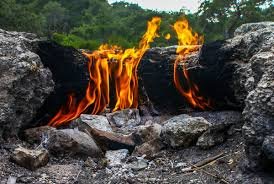
High on the wooded slopes of Mount Olympos in southern Turkey, far from any volcano and untouched by human hand, fire erupts spontaneously from the earth. This is Yanartas, the “Burning Rock,” a place where the boundary between myth and reality flickers as unpredictably as the dozens of flames that have burned here for millennia. Known since antiquity as the Chimaera, this geological marvel is one of the world’s only non-volcanic, perpetual natural fires, a phenomenon that has inspired epic poetry, fueled ancient cult worship, and served as a natural lighthouse for ancient mariners navigating the treacherous Lycian coast. The site is not a single large blaze but a collection of small, bright flames and ethereal blue tongues of fire that issue from vents and fissures in the bedrock, creating an otherworldly landscape, especially when visited after nightfall. The experience of hiking up the ancient stone path through a dark pine forest, only to arrive at a mountainside alive with dancing fire, is profoundly moving, connecting the visitor directly to the same sense of awe that ancient travelers felt over two thousand years ago. Yanartas is more than a curious natural attraction; it is a portal to a time when the world was explained through gods and monsters, and where the very ground beneath your feet was considered sacred, a place where the underworld breathed fire into the world of the living.
The Breath of a Monster
The name Yanartas Chimaera is borrowed directly from Greek mythology, referring to a terrifying fire-breathing hybrid creature, typically described as having the head of a lion, the body of a goat, and the tail of a serpent. The myth, as recounted by Homer in the Iliad and other ancient sources, tells the story of a heroic prince named Bellerophon who was sent to the rugged land of Lycia by a treacherous king, Iobates, with a sealed message demanding his own execution. The reason for this deadly mission was the Chimaera, a monster ravaging the Lycian countryside, a beast so fearsome that “not even a mass of men could subdue it.” Iobates, upon reading the message but bound by the laws of hospitality, could not kill Bellerophon directly. Instead, he set him the impossible task of slaying the Chimaera. With the aid of the winged horse Pegasus, gifted to him by the gods, Bellerophon soared into the air, safely out of reach of the monster’s fiery breath. From this vantage point, he plunged a lead-tipped spear into the Chimaera is jaws. The creature’s own fiery breath melted the lead, which poured down its throat, scorching its insides and finally killing it. The myth explains the natural fires as the last, dying breaths of the slain monster, eternally seeping from the ground where it fell. This story was not just a fable; for the ancients, it was a literal explanation for a terrifying and inexplicable phenomenon, and the site became a place of legendary significance.
A Sacred Site of Fire Worship
Long before it was a tourist attraction, Yanartas was a major religious sanctuary. The perpetual flame made it a natural temple for the worship of fire, one of the most fundamental and sacred elements in the ancient world. The most prominent deity associated with the site was Hephaestus, the Greek god of fire, metalworking, and volcanoes. The Lycians, and later the Greeks and Romans, believed that the fires were a direct manifestation of the god’s subterranean forge, where he crafted weapons and armor for the gods. A little-known story involves the specific rituals performed here. Ancient writers like Pliny the Elder noted that the fires were used for divination. Priests would interpret the flames’ intensity, color, and direction, seeking prophecies from the gods. The site also attracted a mystical sect known as the Hephaisteions, devotees of Hephaestus who maintained a constant vigil at the flames. They believed that by immersing themselves in the “breath of the god,” they could gain spiritual insight and healing powers. The ruins of a small Byzantine chapel built directly amongst the flames in the 5th century AD attest to the site’s enduring sanctity; early Christians often appropriated pagan holy sites, and they likely interpreted the eternal flames as a manifestation of the divine light of God, building their church to sanctify what they saw as a demonic, but powerful, place.
Yanartas Mariner is Beacon
Beyond its mythological and religious significance, the Chimaera served an immensely practical and vital purpose for ancient navigation. The Lycian coast, for all its beauty, is notoriously dangerous for sailors, riddled with hidden rocks and sudden storms. The fires of Yanartas, burning steadily night and day and visible from the sea, became a crucial natural lighthouse. This is a facet of the site’s history that is often overlooked. Ancient mariners sailing between Cyprus, Rhodes, and the Anatolian mainland would use the distinct, steady glow on the mountainside as a key navigational marker. The Roman naturalist Pliny the Elder explicitly mentioned this function, stating that the fire was “a beacon to mariners.” A fascinating and less-known detail involves the strategic importance of this during times of war. The Lycian League, a federation of city-states including nearby Olympos and Phaselis, would have relied on the beacon to guide their warships and monitor naval traffic. It is even speculated that during sieges or naval blockades, the flames could have been temporarily extinguished or obscured to confuse enemy fleets, turning a natural wonder into a tool of military deception. The Chimaera was not just a wonder to be observed; it was an integral part of the region’s economic and military infrastructure for centuries.
The Geological Mystery
The scientific explanation for the eternal flames is as fascinating as the myths surrounding them. Unlike most natural eternal flames, which are associated with volcanic activity or coal seam fires, Yanartas is a result of a unique geological process known as abiotic methane venting. The bedrock of Mount Olympos is rich in serpentinite, a rock formed from the mantle of the earth under high pressure and temperature. Tectonic activity has pushed this rock to the surface, where it is continuously undergoing a slow, low-temperature chemical reaction called serpentinization. When water reacts with the mineral olivine within the serpentinite rock, it produces methane and hydrogen gas. This gas, under pressure, seeps up through fissures and faults in the mountain. When it reaches the surface and comes into contact with oxygen, it can be ignited by the smallest spark—a lightning strike, a stray ember from a campfire, or even friction. Once lit, the flames will burn as long as the gas continues to seep out, which it has done for thousands of years. The flames are cooler than a wood fire, which is why it’s possible to briefly pass a hand through them, and they often burn with a faint blue hue characteristic of methane combustion. This process makes Yanartas one of the largest and most accessible examples of this phenomenon on Earth.
Yanartas The Lost City of Olympos
The flames of the Chimaera cannot be separated from the fate of the ancient city of Olympos, whose sprawling ruins lie in a lush valley just a few kilometers away, opening onto a beautiful pebble beach. Olympos was a major Lycian port city that grew wealthy from trade and, infamously, from piracy. During the 1st and 2nd centuries BC, the city became a stronghold for Cilician pirates who used its hidden coves and the guiding light of the Chimaera as a base for raiding Roman shipping lanes. A little-known story from this era involves the Roman general Publius Servilius Vatia, who was sent to crush the pirate threat in 78 BC. His campaign, known as the Cilician War, culminated in the siege and capture of Olympos. It is said that the pirates, knowing the Romans were coming, attempted to hide their vast plunder somewhere in the labyrinthine river valley surrounding the city, and local legend persists that treasure is still buried there today. After its incorporation into the Roman Empire, Olympos flourished again, and the Chimaera became a popular tourist attraction for wealthy Romans, much as it is today. The city’s eventual decline, hastened by Arab raids and siltation of its harbor, led to its abandonment, and the Chimaera was left to burn alone, its significance remembered only in local folklore and ancient texts until its rediscovery by modern archaeologists and travelers.
A Night Ascent to Another World
The experience of visiting Yanartas today is a deliberate journey that retains a sense of pilgrimage. Visitors typically arrive in the late afternoon or evening at a small car park at the base of the mountain. From there, a well-maintained but steep path, composed of ancient stone steps and modern gravel, winds upward through a dense forest of pine and cedar trees for about half an hour. As daylight fades, the hike becomes increasingly atmospheric, with the scent of pine resin filling the air and the sounds of the forest giving way to an anticipatory silence. The first indication that you are nearing the site is not a sight, but a sound: a faint, persistent hissing. Then, through the trees, you see the flicker of the first flames. Emerging onto the rocky slope is a truly magical moment. Dozens of flames, some small and flickering, others roaring steadily from fissures in the rock, create a dynamic, living landscape of light and shadow. The most powerful vents are fenced off for safety, but many smaller flames are accessible. It is a tradition for visitors to boil water for tea or even cook simple foods like sausages or marshmallows over the fires, a practice that directly connects them to the countless generations who have used this natural wonder for practical purposes. The view from the slope, overlooking the dark expanse of the Mediterranean Sea, is the same vista that ancient sailors saw, making the connection to the past palpable and profound.
Yanartas The Flickering Legacy
The eternal flames of Yanartas have burned for millennia, but their future is not guaranteed. The same geological forces that feed the flames are finite, and there is evidence that the volume of gas escaping has decreased over historical times. Ancient writers like the Roman historian Dio Cassius reported that the flames were once much more vigorous, capable of setting the entire mountain ablaze. Today, many vents have gone out, and the activity is concentrated in a smaller area. Human activity also poses a threat. While the site is a protected area, the sheer number of visitors and the potential for soil erosion and damage to the delicate rock vents are ongoing concerns. There is a delicate balance between allowing access to this unique wonder and preserving it for future generations. The story of Yanartas is a reminder of the transient nature of even the most seemingly permanent natural wonders. It is a legacy of fire that has illuminated human history, from the myths of heroes and monsters to the practical needs of sailors and the spiritual yearnings of priests. To stand on that mountainside at night, surrounded by the breath of the earth, is to participate in a tradition as old as civilization itself, a tradition that depends on our stewardship to ensure the flames of the Chimaera continue to whisper their ancient secrets into the modern night.
Go to main page

