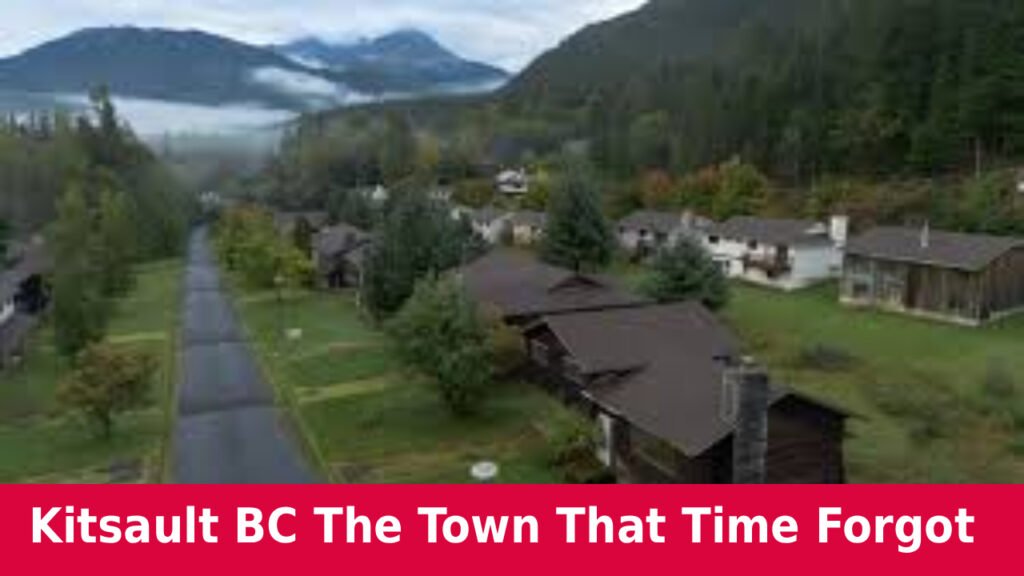
Tucked away at the head of the deep fjord of Alice Arm, 100 kilometers north of Prince Rupert in the rugged wilderness of British Columbia, lies one of the most unusual and enigmatic settlements in North America: the ghost town of Kitsault BC. Unlike most abandoned towns that slowly decay over decades, Kitsault is a community frozen in a single moment in time, a perfectly preserved artifact of the early 1980s that was built for a future that never arrived. It is not a town of crumbling ruins and rotting wood; it is a complete modern municipality with over 100 homes, a shopping mall, a hospital, a swimming pool, and a pub, all maintained in pristine condition, yet entirely devoid of residents. Kitsault’s story is a breathtakingly short and dramatic arc of immense ambition, colossal financial risk, devastating economic collapse, and an enduring mystery centered on the one man who has dedicated his life to preserving this beautiful, empty relic. It is a tale of a $50 million bet on a volatile global commodity, a community that lived for just 18 months, and a time capsule that stands as a stark monument to the boom-and-bust cycles that have shaped Canada and a hauntingly beautiful question mark about its ultimate fate.
The Molybdenum Dream Amax and Billion-Dollar Gamble
Kitsault’s entire existence is tied to the fortunes of a single, unglamorous metal: molybdenum. Often called “moly,” it is a silvery element used primarily as a hardening agent in steel alloys, crucial for everything from military vehicles and oil pipelines to tools and automobile parts. In the late 1970s, with the Cold War ongoing and global industry booming, the price of molybdenum skyrocketed. The American mining giant Amax Inc. saw an opportunity in an old, played-out mine near the long-abandoned original town of Kitsault (founded in the 1910s for silver mining). Geological surveys suggested vast, untapped reserves of moly remained. Convinced the high prices would hold, Amax made an audacious decision. Instead of building a simple mine with a typical work camp, they would construct an entire, self-sufficient, state-of-the-art townsite to attract and retain a stable workforce of engineers, managers, and their families. This was a radical departure from the norm. They envisioned a idyllic, remote community so comfortable and modern that skilled professionals would willingly relocate their families to the isolated coast of British Columbia. It was a monumental gamble, a $50 million investment (over $200 million in today’s dollars) in real estate and infrastructure, all betting that the world’s appetite for molybdenum would remain insatiable.
Building a Utopia The frantic Construction Blitz
In 1979, Amax unleashed a whirlwind of activity on the chosen site, clearing the dense coastal rainforest at a feverish pace. The project was a logistical nightmare. Everything, from the concrete for foundations to the appliances for the homes, had to be brought in by barge along the fjord. At the peak of construction, over 1,200 workers labored around the clock in shifts, battling the region’s infamous rainfall to meet an incredibly aggressive schedule. They weren’t just building houses; they were building an entire modern world from scratch. The plan was meticulously detailed. The townsite would include 16 dormitories for single workers, 92 single-family homes, and 18 apartment units, all featuring the latest in late-70s design and comfort. But it was the amenities that were truly staggering for a remote mining town: a modern 43-bed hospital, a recreation center with a full-sized swimming pool and squash courts, a shopping mall with a grocery store, bank, and liquor store, a two-story pub and restaurant, a library, a theater, and a primary school. The streets were paved, sidewalks were poured, and thousands of trees and shrubs were planted to create an instant community. It was a master-planned utopia, a Potemkin village of suburban idealism constructed in record time, finally opening its doors to residents in 1980.
A Community in Bloom of The Brief Life of a Modern Town
For a short, vibrant period, Kitsault thrived. By 1981, the population had swelled to nearly 1,200 residents. Children played in the newly built playgrounds and attended the school. Families shopped at the mall, gathered for movies at the theatre, and socialized at the pub. The recreation center was a constant hub of activity. For the residents, it was a strange and wonderful experience. They enjoyed all the comforts of a suburban life in a stunningly beautiful and remote location, with the added novelty of being part of a brand-new community. The mine, located 7 kilometers up the mountain, operated three shifts, and the town buzzed with the energy of a place on the rise. Christmas decorations were put up, community events were organized, and life settled into a comfortable, if isolated, rhythm. Photographs from the era show a clean, bright, and seemingly happy community, a testament to the success of Amax’s ambitious social experiment. It was a town filled with hope and the promise of a long, prosperous future, completely unaware that the foundation of its existence was already crumbling on the global market.
The Crash: How 18 Months of Life Ended in 18 Hours
The downfall of Kitsault was as swift and brutal as its creation. The very global economic forces that had made the mine viable suddenly reversed. The early 1980s saw a severe global recession. Demand for steel plummeted, and with it, the price of molybdenum. From a peak of over $20 per pound, the price crashed to under $5. Almost overnight, the Kitsault mine became utterly unprofitable. The math was simple and devastating. In October 1982, just 18 months after the town had officially opened, Amax executives made the decision to close the mine. The announcement was delivered to residents with shocking suddenness. They were given just hours to pack their belongings and leave. Buses and barges were arranged for a mass, immediate evacuation. Families had to abandon their homes, leaving behind furniture, toys in the yards, and food in the freezers. The school closed mid-semester. The hospital was shuttered. The lights in the shopping mall were turned off for the last time. Within a matter of days, the bustling, modern town was completely silent. The $50 million utopia was now a $50 million ghost town, a monument to failed economic forecasting. The company placed a small caretaker crew on site to perform basic maintenance, expecting that perhaps one day, if prices recovered, the town could be reoccupied. That day never came.
The Caretaker and the Millionaire of Kitsault BC
For years, Kitsault BC sat silently, its pristine buildings slowly being reclaimed by the relentless coastal rainforest. It became a legend, a destination for adventurous boaters and a subject of fascination. Its fate seemed sealed: a slow decay into ruin. Then, in 2005, an unexpected savior appeared. Krishnan Suthanthiran, a successful American entrepreneur and founder of a medical supply company, learned about Kitsault. He wasn’t a miner or a speculator; he was a visionary captivated by the town’s story and its potential. He purchased the entire townsite, its buildings, and the surrounding 25,000 acres for a reported $7 million. His motive was not to restart the mine, but to preserve the town. Suthanthiran became Kitsault’s sole resident and obsessive caretaker. He invested millions more of his own fortune into reversing the decay. He employed a full-time maintenance crew to repaint houses, repair roofs, mow the lawns, and keep the power and water systems running. His mission was to keep the town perfectly preserved, exactly as it was left in 1982. He has been known to personally give tours, showing off the untouched hospital with its 1980s equipment, the pub with glasses still behind the bar, and the homes that look ready for their owners to return. He is a modern-day Jay Gatsby, presiding over his beautiful, empty kingdom, guarding a dream that wasn’t even originally his own.
A Time Capsule of 1980s Life Walking Through the Past
The profound eeriness of Kitsault comes from its perfect preservation. Walking its empty streets is like stepping into a museum exhibit of early 1980s life. The shopping mall remains as it was, with its original signage and layout, waiting for customers who will never come. The hospital is a surreal snapshot, with dated medical equipment, gurneys, and even patient records still in place. The school classrooms have desks and chalkboards, frozen in time. The homes, which are maintained inside and out, feature classic 80s interior design: wood paneling, shag carpeting, avocado-green and harvest-gold appliances, and rotary-dial telephones. This is what sets Kitsault apart from every other ghost town. There is no vandalism, no graffiti, no looting. It is not a ruin; it is a suspended animation. This level of preservation offers a unique and uncanny historical record, a perfectly intact slice of a very specific moment in time, untouched by the subsequent decades of technological and cultural change. It is a powerful sensory experience that evokes a deep sense of nostalgia and melancholy.
The Controversial Future: Preservation vs. Purpose
Kitsault BC is existence as a meticulously maintained ghost town raises complex questions about its future. Suthanthiran has floated various grand ideas over the years, including transforming it into a world-class retreat for artists and thinkers, a satellite campus for a university, or a hub for renewable energy research. However, its extreme remoteness is a massive barrier to any of these ventures. There are no plans to revive the molybdenum mine. The Kitsault BC town’s future, therefore, remains its present: a preserved relic. This has sparked a quiet debate. Some see the millions spent on maintenance as a quixotic but noble effort to preserve a unique piece of Kitsault BC history. Others question the purpose of maintaining a ghost town for no one, seeing it as a fascinating but ultimately wasteful eccentricity of a wealthy individual. The town exists in a legal and logistical limbo, a private property with no public access, its fate entirely tied to the will and wealth of its sole owner. Will it remain a time capsule forever? Or will it eventually succumb to the economic or environmental realities of its location?
The Legacy of Kitsault: A Monument to Ambition
The story of Kitsault BC is far more than a simple tale of a mining boom gone bust. It is a powerful allegory for human ambition, the fragility of industry, and the nature of community. It represents the ultimate company town, a community that was entirely conceived, built, owned, and terminated by a corporation. Its residents were merely temporary actors in a corporate drama. The Kitsault BC town is a physical monument to the immense power of global commodity markets, capable of creating and destroying entire worlds in a matter of months. It is a testament to the belief that with enough money and will, you can build utopia anywhere—and a warning that no amount of money can control the global economy. Kitsault’s silence speaks volumes about the cycles of resource extraction that have built Canada, and the ghostly, beautiful remnants they can leave behind. It stands as a hauntingly beautiful question mark, a place that forces us to ponder the line between preservation and decay, between memory and reality, and between a home and a house waiting for someone to finally come home.
Go to main page

