
Beneath the impossibly clear, turquoise waters of the Mediterranean Sea, along the ruggedly beautiful coast of ancient Lycia in modern-day Turkey, lies a scene of serene and haunting beauty: the Sunken City of Kekova. This is not a single lost metropolis like the mythical Atlantis, but a vast and evocative archaeological landscape where the line between land and sea has been permanently blurred. Here, the remnants of a sophisticated civilization—crumbling staircases that lead into the deep, foundations of homes and public buildings, shattered amphorae scattered on the seabed, and a lone sarcophagus resting eternally underwater—silently narrate a tale of seismic catastrophe, historical continuity, and the irresistible power of nature. The Kekova region, encompassing the sunken ruins off the northern shore of Kekova Island and the picture-perfect villages of Kaleköy (ancient Simena) and Üçağız (ancient Teimiussa), is a unique open-air museum, a place where one can kayak over ancient history and walk through villages that have been continuously inhabited for millennia. It is a place that captures the imagination not through grand, reconstructed monuments, but through its palpable sense of mystery and the quiet, profound dialogue between human endeavor and geological force.
The Lycian League: A Cradle of Democracy Before Its Time
To truly appreciate Kekova Sunken City, one must first understand the remarkable people who built it: the Lycians. In an era dominated by empires and autocracies, the Lycian League, a federation of ancient city-states that flourished in the first millennium BC, stood out as a fascinating early experiment in representative democracy. This political union, which included major cities like Xanthos, Patara, and Myra, as well as the smaller ports of Simena and Teimiussa in the Kekova area, was so admired by its contemporaries that the founding fathers of the United States later drew inspiration from its model when drafting the U.S. Constitution. The Lycians were a resilient, independent people, fiercely protective of their freedom, with their own unique language, culture, and funerary architecture. Their most distinctive legacy is their elaborate rock-cut tombs, carved to resemble the facades of wooden houses, which dot the cliffsides of the entire region, including those overlooking the sunken ruins. These tombs, believed to be the eternal homes of the deceased, were placed with great care, often overlooking the sea or the city, a testament to a deep connection between the living, the dead, and the majestic landscape they inhabited. The settlements around Kekova were vital parts of this federation, serving as important trading ports and naval outposts in a confederation known for its powerful fleet.
A Landscape Forged by Seismic Violence
The breathtaking underwater spectacle of Kekova was not caused by a slow rise in sea levels but by a sudden and violent geological event. The entire Mediterranean basin is a highly active seismic zone, where the African and Eurasian tectonic plates collide. Sometime in the 2nd century AD, a massive earthquake, one of a series that has repeatedly reshaped the Anatolian coastline, struck the region with devastating force. The ground shuddered and fractured, and in a matter of minutes, a significant portion of the coastline, including parts of the ancient cities on what is now Kekova Island, dropped several meters into the sea. This event, known as tectonic subsidence, instantly submerged everything built upon the fallen block of land. Seawater rushed into streets, flooded homes and workshops, and swallowed the lower parts of the city’s infrastructure. While it is a common misconception that the entire city was lost in one cataclysmic event, the earthquake was the primary catalyst, dooming these specific sections to a future beneath the waves. Subsequent smaller tremors over the centuries continued to alter the coastline, further settling the ruins into their aquatic grave and adding to the layered mystery of the site.
Kekova Sunken City The Silent Streets Beneath the Waves: A Kayaker’s Perspective
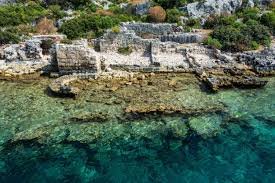
The most intimate and environmentally conscious way to experience the Kekova Sunken City is by gliding over it in a transparent-bottomed kayak or a small, quiet boat. From this vantage point, the underwater world unfolds like a living map. The defining feature is a long, submerged wall, often called the “sea wall,” which runs parallel to the shore of Kekova Island. This is not a defensive fortification but likely a retaining wall for a major street or a series of buildings that once stood above it. Peering down through the crystalline water, one can make out the outlines of stone foundations that once supported houses and public structures. The most poignant sights are the mundane details of ancient life frozen in time: a stone staircase descending into nothingness, its steps now covered in soft sea grass and anemones; the rectangular cuttings in the bedrock that held storage jars for oil and wine; and the scattered fragments of ceramic amphorae that litter the seabed like forgotten puzzle pieces. These amphorae, the shipping containers of the ancient world, hint at the city’s former role as a bustling trade hub. Swimming is now strictly prohibited over the main sunken area to protect the fragile ruins, but the view from above is more than sufficient to ignite the imagination and convey a powerful sense of a world interrupted.
Kaleköy: The Living Guardian of Simena
Directly opposite the sunken ruins, clinging to the slopes of the mainland, is the enchanting village of Kaleköy, the site of ancient Simena. This is not a deserted archaeological site but a living, breathing community where modern life is inextricably woven into the ancient fabric. The village is inaccessible by road, reachable only by sea, which has preserved its timeless charm. One of the most captivating little-known stories involves the direct reuse of history. Villagers for generations have used the magnificent Lycian sarcophagi that are scattered throughout the village and even in the shallow waters of its harbor as everything from planting boxes for flowers to makeshift benches and tables. A sarcophagus lid might serve as a base for a garden wall, and an ancient stone block is seamlessly incorporated into a modern home’s foundation. This is not disrespect but a form of continuous, practical coexistence with the past that is unique to this region. The pinnacle of Kaleköy is crowned by a small, rugged Crusader-era castle, built upon ancient Lycian foundations. Climbing to its walls rewards the visitor with arguably one of the most spectacular views in all of Turkey: a panoramic vista of the entire Kekova sound, with the sunken city clearly visible below and the endless blue of the Mediterranean stretching to the horizon.
Üçağız: The Triple Mouth of Ancient Teimiussa
A short boat ride away from Kaleköy is the village of Üçağız, whose name meaning “three mouths” refers to the three channels that connect its natural harbor to the open sea. This was the site of ancient Teimiussa, another Lycian city that suffered from the same earthquakes. While it lacks the dramatic castle of Simena, Üçağız offers a different kind of magic. Its harbor is similarly dotted with Lycian sarcophagi, some half-submerged, standing as silent sentinels to history. The land behind the village is a sprawling, often-overlooked archaeological site where keen-eyed explorers can find ruins of Lycian and Roman houses, more tombs, and ancient olive presses slowly being reclaimed by nature. A little-known path leads out of the village to the east, winding through fragrant maquis shrubland and past countless unexcavated ruins before eventually connecting to the ancient site of Apollonia. This walk is a journey through untouched history, offering a sense of discovery that is rare in more frequented archaeological parks. Üçağız serves as a quieter, more contemplative base for exploring the region, a place where the layers of Lycian, Roman, Byzantine, and Ottoman history feel deeply personal and immediate.
From Pirate Haven to Protected Paradise of Kekova Sunken City
The history of the Kekova region did not end with the Lycians or the earthquakes. Its secluded coves, hidden harbors, and complex coastline made it a perfect haven for pirates throughout the centuries, particularly during the Middle Ages. The Byzantine Empire and later the Knights of Rhodes built the castle atop Simena precisely to try and control this illicit activity and protect the coastal trade routes. This era of lawlessness and naval skirmishes added another layer of history to the area. In the modern era, the entire Kekova area was declared a specially protected area in 1990 by the Turkish government to preserve its unique cultural and natural heritage. This status strictly regulates all activity, prohibiting any new construction, unauthorized diving, or even swimming over the sunken city itself. This protection has been crucial in safeguarding the ruins from looters and the damaging effects of mass tourism, ensuring that the delicate underwater archaeology remains intact for future study. The preservation effort has turned Kekova into a model for sustainable cultural tourism, where visitors can experience its wonders without loving it to death.
Kekova Sunken City The Enduring Allure of a Liquid History
The Sunken City of Kekova endures as one of Turkey’s most captivating and unique historical destinations precisely because it is not a reconstructed relic behind glass. It is an emotional and sensory experience. It is the sound of water lapping against a two-thousand-year-old stone step, the sight of octopuses making homes in ancient pottery, and the feeling of awe that comes from understanding the immense geological forces that can reshape a civilization in an instant. It challenges the conventional museum experience, offering instead a living landscape where history is embedded in the very water and stone. It is a place that speaks to the transience of human empires and the enduring power of the natural world, a poignant reminder that the ground beneath our feet is not as solid as it seems. To visit Kekova is to witness a beautiful tragedy frozen in time, to kayak over a lost world, and to connect with the legacy of the ingenious Lycians in the most direct and unforgettable way possible.
Go to main page

