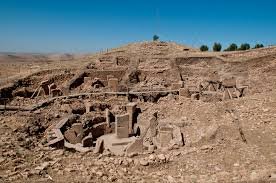
Perched atop a barren limestone ridge in southeastern Turkey, just outside the ancient city of Sanlıurfa, lies Gobekli Tepe, a site that has single-handedly upended our entire understanding of human prehistory. Translating to “Potbelly Hill,” this unassuming name belies a reality so profound that archaeologists and historians are still grappling with its implications. Gobekli Tepe is not merely old; it is astoundingly ancient, dating back to a staggering 9600 BCE, a time conventionally categorized as the pre-pottery Neolithic period, when humans were thought to be simple hunter-gatherers, living in small, nomadic bands, their lives consumed by the daily struggle for survival. The discovery of Gobekli Tepe shattered this paradigm, revealing a complex, monumental sanctuary constructed by these very people thousands of years before the invention of writing, the wheel, or settled agriculture. This is not a settlement but a temple, a series of vast, circular enclosures defined by massive, T-shaped limestone pillars, each weighing tons and intricately carved with a breathtaking menagerie of animals, abstract symbols, and enigmatic humanoid forms. Its existence forces a monumental question: which came first, the cathedral or the city? Gobekli Tepe suggests that the human impulse to gather for ritual, to create art and architecture dedicated to the cosmos, may have been the very catalyst that spurred the development of agriculture, society, and civilization as we know it.
A Discovery Sight of Gobekli Tepe
The story of Gobekli Tepe’s modern discovery is a tale of overlooked potential and scholarly perseverance. The hill was not unknown; indeed, it had been noted in a groundbreaking 1963 American archaeological survey, but the team, upon finding scattered Neolithic flints and limestone slabs they misinterpreted as Byzantine grave markers, dismissed its significance. For over three decades, the hill remained a footnote. The true revelation began in 1994 when a German archaeologist, the late Professor Klaus Schmidt, re-examined the survey reports and decided to visit the site. A veteran of early Neolithic sites, Schmidt instantly recognized the truth. The so-called grave markers were the tops of immense, buried pillars. The flints were not from a simple campsite but from a major Pre-Pottery Neolithic quarry and workshop. He knew immediately he was standing on something extraordinary. A little-known detail of this discovery involves a local farmer named Savak Yildiz, who had long before pointed out the strange, protruding stones to researchers, his intuition about the land passed down through generations. Schmidt’s genius was in listening and seeing what others had missed. When excavations began in 1995, led by the German Archaeological Institute in collaboration with the Sanlıurfa Museum, they quickly revealed the first of the monumental pillars, confirming Schmidt’s revolutionary hypothesis: this was the oldest known megalithic structure in the world, a discovery that would demand a rewrite of every textbook on the Neolithic revolution.
Gobekli Tepe Stone Age
The architecture of Gobekli Tepe is its most immediately stunning feature, a testament to a level of organization and sophistication previously deemed impossible for its time. The site comprises multiple enclosures, or temples, spread across the hilltop. Each enclosure is strikingly similar in its basic layout: two massive, central T-shaped pillars surrounded by a circular wall of slightly smaller, but equally imposing, pillars. These pillars, carved from the local bedrock using primitive stone tools, stand up to 5.5 meters (18 feet) tall and weigh an estimated 10 to 20 tons each. The engineering challenge of quarrying, shaping, transporting, and erecting these monoliths is staggering. How did hunter-gatherers achieve this without draft animals, wheels, or metal tools? The prevailing theory involves the use of hundreds of people, employing levers, ropes, and mud ramps—a feat requiring not just brute strength but sophisticated planning, leadership, and a shared, highly motivated purpose. The T-shape of the pillars is universally interpreted as stylized human figures, with the top bar representing the head and the shaft the body. This is confirmed by the presence of carved arms, hands, and loincloths on some of the pillars, suggesting a gathering of stone ancestors or deities overseeing the rituals within the sacred space.
The Enigmatic Carvings
Beyond their sheer scale, the pillars are a canvas for a vast and intricate collection of carvings, creating the world’s oldest known monumental narrative art. This is not random decoration; it is a dense, symbolic language carved in stone. The most prominent motifs are animals, rendered in high and low relief with astonishing skill and vitality. A mesmerizing bestiary includes foxes, snakes, wild boars, gazelles, cranes, ducks, and fearsome predators like lions, leopards, and hyenas. These are not the docile, domesticated animals of a farming society but the wild, dangerous, and revered creatures of the hunter-gatherer world. A particularly fascinating and less-publicized detail is the prevalence of carvings of headless humans and human heads held by vultures or placed in niches, which scholars like Schmidt linked to emerging death cults and sky burial practices, where the dead were left exposed for birds to carry their souls to the heavens. Abstract symbols, including H-shapes, crescents, and disks, are interspersed throughout, their meanings lost to time. This rich iconography suggests a complex mythological universe, a world where humans, animals, and spirits were deeply interconnected, and where the rituals performed at Gobekli Tepe were likely intended to negotiate that relationship, perhaps for protection, fertility, or divine favor.
The Deliberous Burial of a Sanctuary
One of the most profound mysteries of Gobekli Tepe is not its construction, but its demise. Around 8000 BCE, after more than a millennium of use, the entire site was deliberately and meticulously buried. This was not an accidental abandonment or a sudden catastrophe; it was a con
scious, labor-intensive act. Every enclosure was filled with an immense amount of earth, stone, and animal bones, effectively entombing the entire complex and preserving it in a near-pristine state for millennia. Why would a people who invested so much collective effort into building this sacred landscape decide to bury it? There is no definitive answer, but several compelling theories exist. Some scholars suggest a major religious or cultural shift, where old beliefs were supplanted by new ones, and the ancient temple was interred as a form of ritual closure or to seal away powerful spirits. Others propose that the social structure that built Gobekli Tepe was transforming into a more agricultural, settled society, and the old hunter-gatherer symbols and gathering places lost their relevance. The burial act itself is a testament to the site’s enduring significance; it was too important to simply abandon. It had to be decommissioned with intention, a final, respectful act that ultimately became the reason for its incredible preservation, saving its delicate carvings from erosion and later human interference.
The Cradle of Civilization?
Gobekli Tepe’s greatest impact is on a theoretical level, fundamentally challenging the long-held sequence of the Neolithic Revolution. The traditional model was straightforward: first, humans discovered agriculture, which led to food surpluses. These surpluses allowed for sedentary life in villages, which in turn led to social stratification, specialized labor, and eventually, the complex societies that could build monuments and develop writing. Gobekli Tepe turns this model on its head. It was built by hunter-gatherers before the widespread adoption of agriculture. This suggests a reverse causality: the need to feed large groups of people gathered for ritual construction and ceremony may have driven the domestication of plants and animals. Schmidt’s “cathedral” theory posits that it was the need to supply the builders and participants at this central cult site that prompted the first organized cultivation of wild cereals like einkorn wheat, the ancestors of which are native to the surrounding hills. In this light, Gobekli Tepe was not a product of civilization, but its catalyst. It was the gravitational center that pulled people together, fostering the exchange of knowledge, the development of complex social structures, and the economic pressures that would eventually lead to the domestication of the world around them.
The City of Pool of Sacred Fish
The context of Gobekli Tepe cannot be separated from its remarkable home, Sanliurfa, known historically as Edessa. This ancient city is steeped in legend and tradition, often called the “City of Prophets,” with a history that intertwines with that of the nearby temple. Local lore holds that Sanliurfa is the biblical city of Ur, and its most sacred site, the Balikligul (Pool of Sacred Fish), is believed to be the place where the prophet Abraham (Ibrahim) was thrown into a fire by the tyrant Nimrod, only for God to turn the flames into water and the burning logs into sacred carp. These fish, which thrive in the pool, are considered holy and are never eaten. A little-known story connects this deep-seated cultural memory to Gobekli Tepe. Some archaeologists and local historians speculate that the site’s importance as a spiritual center may have persisted in cultural memory for millennia, influencing the later sacred geography of the region. The profound sense of sanctity that permeates Sanliurfa, with its caves, holy springs, and ancient mosques, may have very deep roots indeed, perhaps stretching back to the spiritual world symbolized by the carvings on the T-shaped pillars, creating a tangible, living link between the world’s oldest known temple and the enduring religious traditions of today.
Legacy and Ongoing Mystery
Today, Gobekli Tepe, a UNESCO World Heritage Site since 2018, is protected and studied with cutting-edge technology. Geophysical surveys indicate that only a fraction of the site has been excavated, with perhaps another 20 enclosures still buried, waiting to reveal their secrets. The work continues under the Turkish Ministry of Culture and Tourism, with new discoveries emerging regularly. The site’s legacy is immense; it has democratized the narrative of civilization’s dawn, showing that monumental achievement was not the sole province of later Mesopotamian cities but had its origins in the collective will of prehistoric hunter-gatherers. It stands as a humbling reminder that our prehistoric ancestors were not primitive brutes but were intellectually, spiritually, and artistically our equals, capable of visionary projects that united people across a vast region. Gobekli Tepe does not provide easy answers; instead, it asks profound questions about the nature of belief, community, and innovation. It is a portal to a forgotten world, a stone symphony from the dawn of time that continues to challenge what we know about our own story.
Go to main page