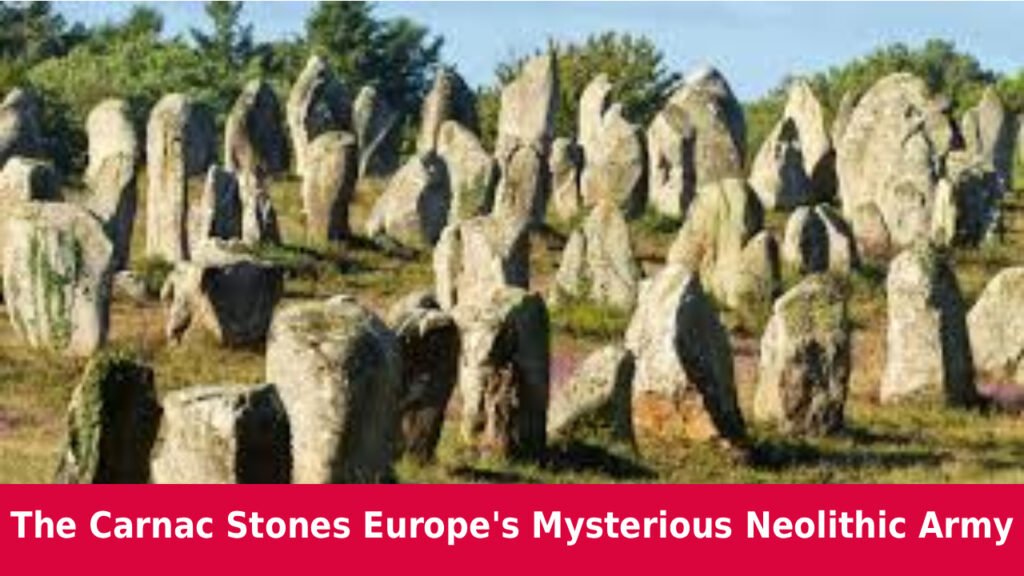
A Landscape Frozen in Time
On the windswept southern coast of Brittany, France, lies one of the most extraordinary and baffling archaeological sites on Earth: The Carnac Stones. This is not a single monument but an vast, sprawling complex of over 3,000 prehistoric standing stones, known as menhirs, erected over a period of 2,000 years during the Neolithic era. Arranged in seemingly perfect rows that stretch for kilometers across the landscape, the stones form the largest such collection in the world. The main alignments are divided into three primary groups—Ménec, Kermario, and Kerlescan—each containing hundreds of gigantic stones, some weighing several tons, standing in eerie, silent procession. The sheer scale of the site is overwhelming; the Ménec alignment alone features 1,099 stones arranged in 11 converging rows. Unlike the famous circle at Stonehenge, the purpose of these linear formations remains one of archaeology’s greatest enigmas. They are a testament to a lost civilization’s incredible ambition, organizational skill, and spiritual belief, a puzzle carved in granite that has resisted definitive explanation for millennia, earning them the nickname “the stone army of Carnac.”
The Builders of The Carnac Stones
The story of the Carnac stones begins with the sophisticated Neolithic communities that inhabited Brittany between 4,500 and 2,000 BC. These were not primitive people but organized farmers, herders, and skilled engineers who had mastered agriculture, pottery, and complex social organization. The construction of the alignments was a project of staggering ambition that would have required generations of sustained effort. Quarrying the massive granite stones from local outcrops, transporting them—likely on wooden rollers and sledges—across difficult terrain, and erecting them with precise alignment required not only immense physical labor but also sophisticated mathematical and astronomical knowledge. This was a society capable of long-term planning and communal action on a scale that is difficult to comprehend today. The effort speaks to a motivation that was central to their entire worldview, suggesting the alignments were the beating heart of their spiritual and cultural life. The fact that they continued this tradition for centuries indicates that the purpose was deeply ingrained, a fundamental part of their identity that was passed down from one generation to the next, long after the original reasons were forgotten.
Theories of Purpose
For centuries, scholars and enthusiasts have proposed a multitude of theories to explain why the Carnac alignments were built. The most enduring theory is an astronomical one: that the rows functioned as a gigantic observatory or calendar system. Some researchers have noted that the major axes of the alignments appear to be oriented toward the sunrise at the solstices, suggesting they were used to mark the changing seasons, which was critical for agricultural societies. Another prominent theory posits a religious or ceremonial function, that the lines defined a sacred processional path for rituals related to ancestor worship. The stones themselves may have represented the ancestors, serving as permanent mediators between the world of the living and the spirit world. More speculative theories, now largely debunked, suggested the stones were a petrified Roman legion turned to stone by the wizard Merlin or that they acted as seismic predictors. A compelling modern hypothesis suggests the alignments were part of a vast cosmological map, with the rows representing territorial boundaries or pathways for the dead, connecting burial mounds (tumuli) and dolmens in a complex sacred geography that covered the entire region.
The Little-Known Mounds and Chambers
While the alignments are the most visually stunning feature, the Carnac complex is far more than just rows of stones. Scattered throughout the area are numerous burial mounds and passage graves that are integral to understanding the site’s full significance. The most impressive of these is the Saint-Michel tumulus, a massive artificial hill built around 4,500 BC that dominates the landscape. This enormous earthen mound, over 125 meters long and 12 meters high, contains several stone burial chambers within it. Excavations in the 19th century uncovered a wealth of grave goods, including polished stone axes, pearls, callaïs (a green decorative stone), and other valuable artifacts, indicating it was the tomb of a high-status individual, perhaps a chief or a priest. Another key site is the Kercado tumulus, a passage grave topped with a solitary menhir that is older than the alignments themselves. These structures reveal that Carnac was primarily a vast necropolis, a city of the dead, and that the alignments were likely part of a funerary landscape, guiding the spirits of the deceased or marking territory belonging to powerful ancestral clans.

The Christianization of The Carnac Stones
With the arrival of Christianity in Brittany, the standing stones, which had been venerated for millennia, became a problem for the new religion. They were potent symbols of the old pagan beliefs and needed to be neutralized. Rather than undertaking the impossible task of destroying thousands of massive stones, the Church pursued a strategy of appropriation and demonization. Many menhirs were Christianized by having crosses carved into their tops or being re-dedicated to saints. Local folklore was actively reshaped; the stones were no longer the work of ancient ancestors but were instead explained as a Roman legion turned to stone by Pope Cornelius for their paganism, or as the devil himself, who was said to have been building a stone bridge to the island of Belle-Île and dropped them when his sack tore. This deliberate overwriting of the stones’ history successfully obscured their original meaning for centuries, embedding them into a new Christian narrative that severed the cultural connection between the local people and the Neolithic builders, allowing the true purpose of the alignments to fade into legend.
The Struggle for Preservation
The modern history of the Carnac alignments is a story of a long struggle between private ownership, scientific inquiry, and preservation. For much of the 19th and early 20th centuries, the stones were largely neglected, used by farmers as fences or quarried for building materials. The rise of archaeology brought renewed interest, but also the threat of irresponsible excavation. A major turning point came in the early 20th century when the French government began to recognize the site’s immense value and started acquiring the land. The real preservation battle was led by a local man, Zacharie Le Rouzic, who dedicated his life to studying and protecting the monuments, eventually becoming the curator of the James Miln archaeological museum in Carnac (now the Museum of Prehistory). Today, the stones are protected as a French National Heritage site and are on the tentative list for UNESCO World Heritage status. Access to the main alignments is now restricted in summer to guided tours on designated pathways to prevent erosion and damage, a necessary compromise to ensure that this unique landscape survives for future generations.
Modern Mysteries and Esoteric Attractions
In the 20th and 21st centuries, the Carnac stones have attracted a new wave of interest from those outside the field of mainstream archaeology. The site has become a magnet for dowsers, geomancers, and New Age practitioners who believe the alignments sit upon powerful ley lines or telluric energy currents. They claim to feel strong vibrations or energy fields emanating from the stones, particularly from the larger menhirs. Some ufologists have even proposed that the straight lines served as landing markers for ancient extraterrestrial spacecraft. While these theories lack scientific evidence, they speak to the enduring power of the stones to captivate the human imagination. They are a canvas onto which people project their own beliefs about the past, the mystical, and the unknown. This esoteric interest has become a part of the site’s modern identity, adding another layer of mystery to the already enigmatic monuments.
The Carnac Stones Experiencing
Visiting The Carnac Stones alignments is a profoundly moving experience. The best way to appreciate their scale is to start at the Maison des Mégalithes visitor center to understand the context before walking the perimeter paths around the fenced-off Ménec and Kermario alignments. The sight of a thousand stones marching across the heather-covered landscape is unforgettable. To escape the crowds, visit the smaller Kerlescan alignments or the quieter Petit-Ménec site in the woods. A climb to the top of the Saint-Michel tumulus offers a breathtaking panoramic view of the entire complex. No visit is complete without exploring the excellent Museum of Prehistory in Carnac village, which houses the stunning collection of artifacts found in the tombs, providing a tangible connection to the people who built this stone army. Whether you are an archaeology enthusiast, a spiritual seeker, or simply a curious traveler, the Carnac stones offer a unique opportunity to walk in the footsteps of a lost world and stand before a mystery that continues to defy time.
Go to main page